• 🧠 Simulation World Philosophy: Are We Living in a Simulation?

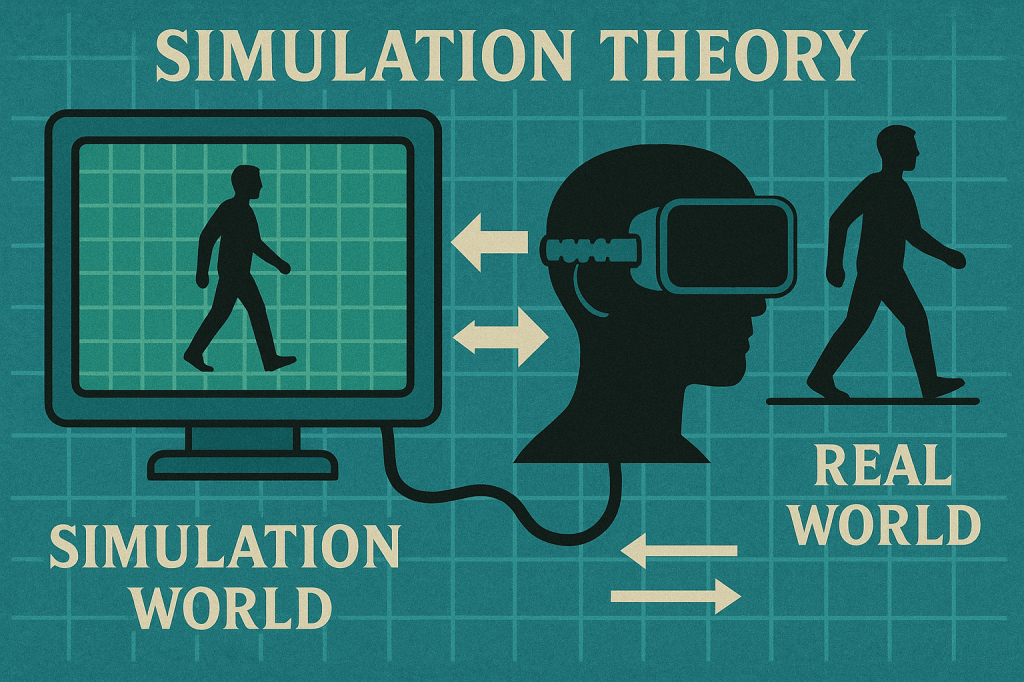
    The Simulation Hypothesis is a fascinating idea in modern philosophy, science, and tech culture. It suggests:

    Our entire reality—including Earth, the universe, and even ourselves—might be an artificial simulation, like a super-advanced video game or computer program.

    Let’s break it down.


    🧩 Origin of the Idea

    📜 Plato’s Cave (Ancient Greece)

    One of the first simulation-like ideas:

    • Prisoners live in a cave seeing only shadows on the wall.
    • They think the shadows are reality.
    • But true reality exists outside the cave.

    This reflects how we might be experiencing only a limited version of what’s real.


    🧠 Nick Bostrom’s Simulation Argument (2003)

    A Swedish philosopher proposed a mathematical logic:

    At least one of the following must be true:

    1. Civilizations never reach the tech to simulate universes.
    2. Advanced civilizations don’t care to simulate past civilizations.
    3. We are almost certainly living in a simulation.

    If future beings can and do simulate universes—there could be billions of simulated worlds for every “real” one.


    🧬 Supporting Clues (Speculative but Interesting)

    • Quantum uncertainty behaves like a system rendering pixels only when observed—like a game engine.
    • The universe has computational limits, like the Planck length and maximum information storage.
    • Simulated environments can’t be told from real ones if the simulation is perfect.

    🎮 Real-World Analogy

    Imagine a video game like The Sims, but incredibly advanced.
    What if the characters in it had emotions, thoughts, and free will?
    From their point of view, the game world is reality.


    🚫 Arguments Against the Hypothesis

    • Unfalsifiable: You can’t prove or disprove it—it may not be scientific.
    • Complexity problem: Simulating a conscious universe might be too demanding, even for a super-civilization.
    • Meaning remains: Even if we are simulated, it doesn’t make our experiences meaningless—pain, love, beauty, struggle still feel real.

    🧘‍♂️ Comparison to Ancient Philosophies

    PhilosophyConcept
    Vedanta (India)World is Maya (illusion); true self is beyond matter.
    BuddhismReality is impermanent; awareness is fundamental.
    GnosticismThe material world is a flawed illusion; the true realm is spiritual.

    🌀 Final Thought

    The Simulation Hypothesis doesn’t claim reality is fake—just that what we call “real” might be a layer, not the base.

    Whether code or atoms, the mystery of being remains just as deep.
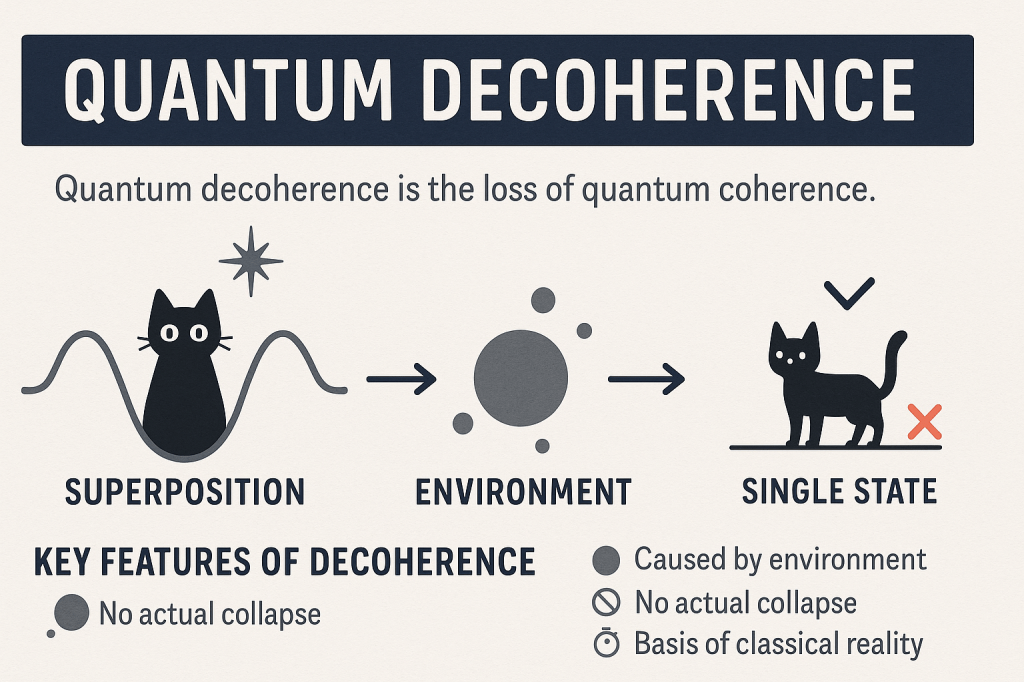

  • 🧠 What Is Quantum Decoherence?

    Quantum decoherence is the process by which a quantum system loses its “quantumness”—that is, it transitions from behaving like a quantum object (with superpositions, interference, entanglement) to behaving like a classical object we see in daily life.


    🌟 Imagine This:

    In quantum mechanics, a particle can exist in a superposition—being in multiple states at once (like Schrödinger’s cat being both dead and alive).

    But in real life, we never observe such weird states. Why?


    🎭 Decoherence Explains the Collapse (Sort of…)

    When a quantum system interacts with its environment (like air, light, atoms nearby), this interaction causes the delicate superposition to “leak” into the environment.

    The quantum information gets spread out and becomes practically impossible to retrieve.
    The system looks like it has “chosen” a single state.


    🔬 Key Features of Decoherence:

    FeatureDescription
    Caused by environmentEven tiny interactions ruin superpositions.
    No actual collapseIt’s not about a particle deciding a state—it’s about information becoming inaccessible.
    Very fastHappens on incredibly short time scales (nanoseconds or faster).
    Basis of classical realityExplains why the world around us doesn’t look quantum.

    🌀 Decoherence ≠ Wavefunction Collapse

    • Decoherence: Mathematical process from entangling with environment.
    • Collapse: Postulated in standard quantum mechanics when a measurement is made.

    Decoherence makes collapse appear to happen—without needing to “break” quantum rules.


    📦 Real-World Implications

    • Quantum computing: Decoherence is the biggest enemy—it destroys qubits.
    • Quantum biology: Some biological processes seem to avoid decoherence for a while.
    • Many-worlds interpretation: In this view, decoherence causes branching into alternate outcomes without true collapse.

  • The Mystery of Complex Numbers – Explained Simply

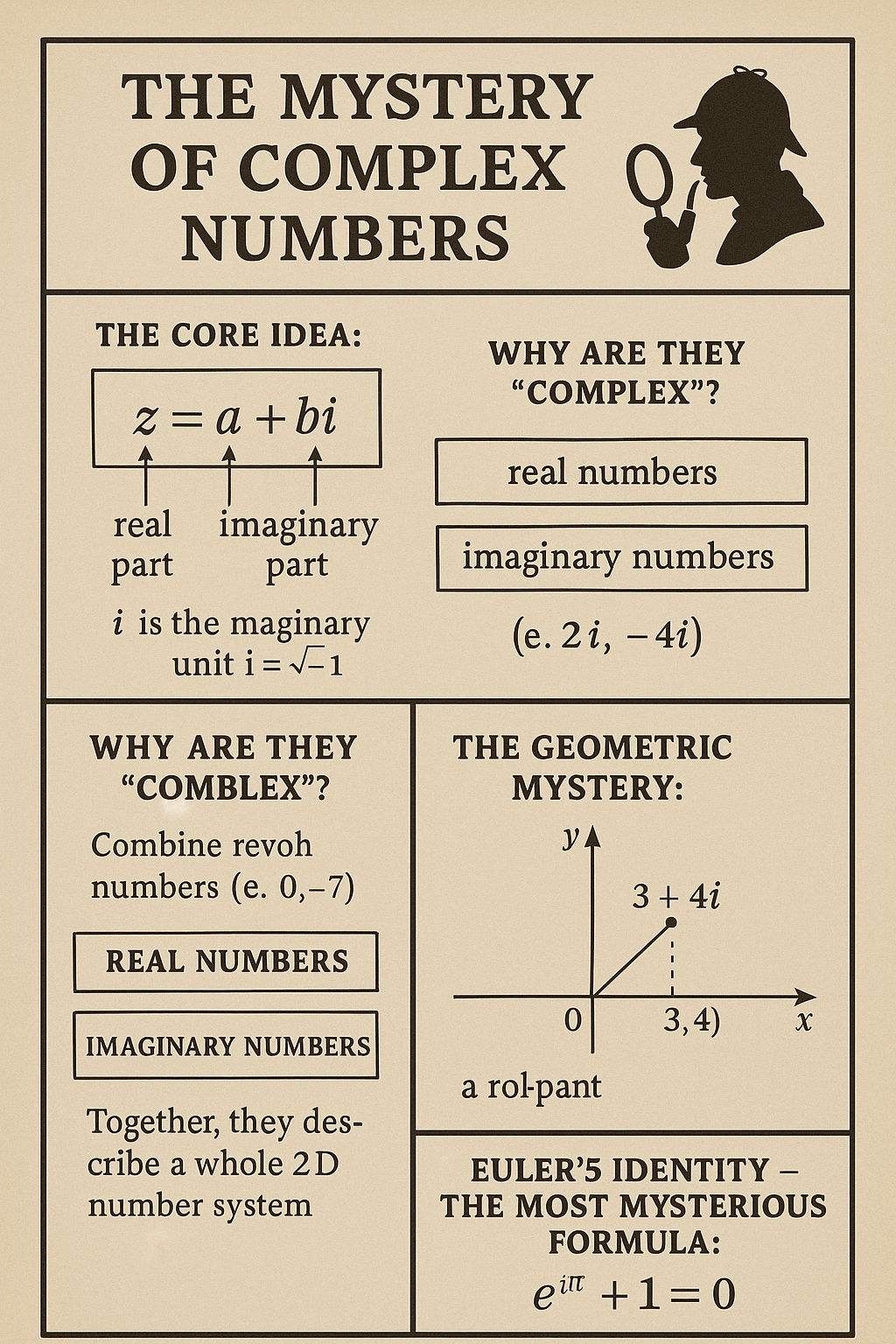
    🧩 What is the mystery of complex numbers?

    At first glance, complex numbers seem unreal—literally. They involve the square root of a negative number, something that can’t exist on the real number line. But they turn out to be incredibly real and powerful in mathematics, physics, and engineering.


    🧠 The Core Idea:

    A complex number is of the form: z=a+biz = a + bi

    Where:

    • aa is the real part
    • bb is the imaginary part
    • ii is the imaginary unit, defined as:

    i=−1i = \sqrt{-1}

    So, i2=−1i^2 = -1 — and that’s where the mystery starts.


    ⚡ Why are they “complex”?

    Because they combine both:

    • Real numbers (like 3, 0, -7)
    • Imaginary numbers (like 2i,−4i2i, -4i)

    Together, they describe a whole 2D number system, expanding the 1D real number line.


    🌌 The Geometric Mystery: Argand Plane

    Visualize real numbers on a horizontal line.

    • Complex numbers live in a plane (called the Argand plane).
      • Real part → x-axis
      • Imaginary part → y-axis

    So a complex number like 3+4i3 + 4i is a point (3, 4) in 2D space.

    It turns out that multiplying complex numbers corresponds to rotating and scaling vectors in this plane — a beautiful and deep result.


    🔁 Euler’s Identity – The Most Mysterious Formula:

    eiπ+1=0e^{i\pi} + 1 = 0

    This connects five of the most important constants in math:

    • ee (natural log base)
    • ii (imaginary unit)
    • π\pi (circle ratio)
    • 11
    • 00

    This elegant formula links exponentials, trigonometry, and complex numbers in one line. It’s often called the “most beautiful equation in mathematics.”


    🛠️ Where Do We Use Complex Numbers?

    1. Electrical Engineering – Alternating current (AC) analysis
    2. Quantum Mechanics – Wave functions are complex
    3. Signal Processing – Fourier transforms use them
    4. Control Systems & Robotics – Complex poles and stability
    5. Fractals & Chaos Theory – Mandelbrot sets are based on complex numbers

    🔍 The Real Mystery:

    They don’t exist on the real line, but they solve real problems better than real numbers alone.

    The biggest mystery is how something imaginary leads to very real insights in our world.


    Would you like an illustrated diagram or a PDF version of this explanation?

  • The mystery of Parallel world

    🌌 What Is a Parallel World?

    A parallel world is a hypothetical universe that exists outside or alongside our own, possibly with different:

    • Physical laws
    • Histories
    • Timelines
    • Versions of you or events

    These are part of what’s called the “multiverse” — a collection of multiple possible universes.


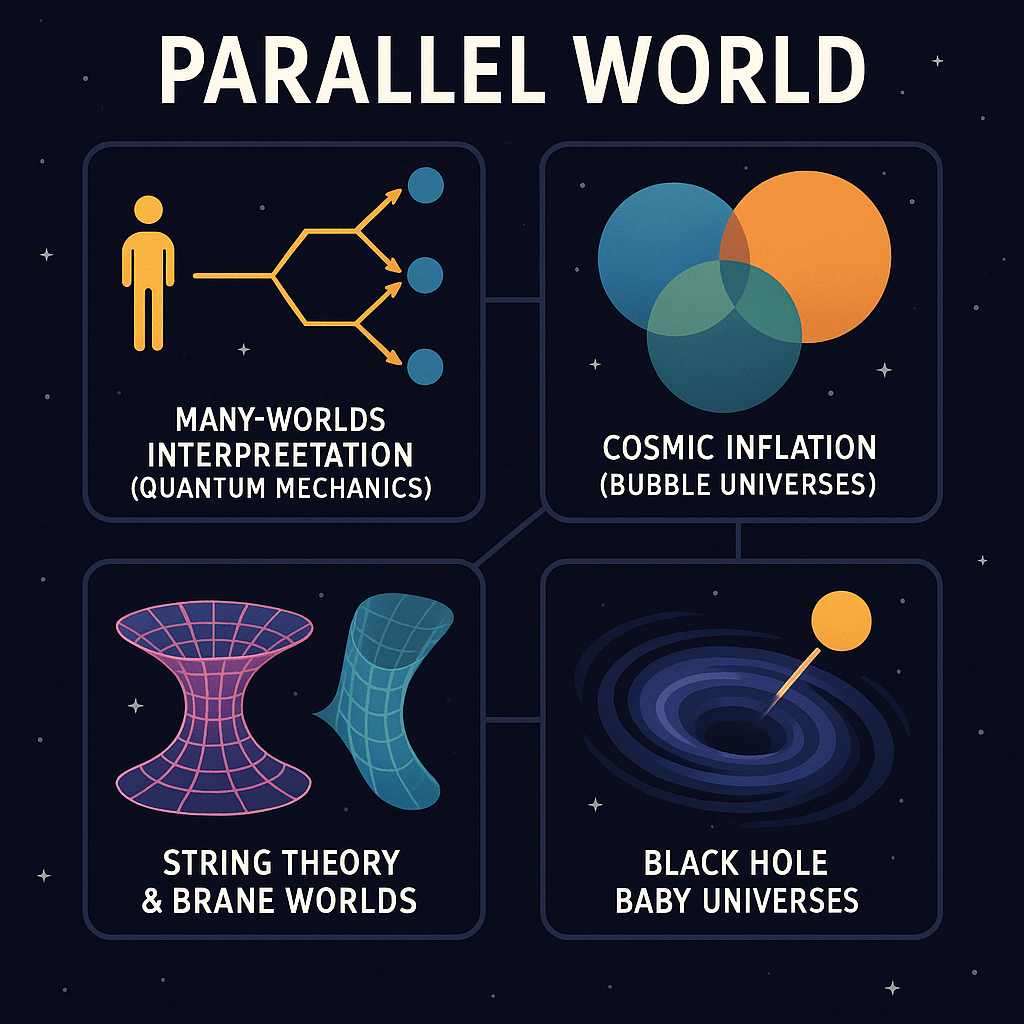
    🧠 Scientific Theories That Support Parallel Worlds

    1. 🧩 Many-Worlds Interpretation (Quantum Physics)

    • Every time a quantum event occurs (like a particle spin), all possible outcomes happen in separate, branching universes.
    • Example: If you flip a coin, one universe sees “heads,” another “tails.”
    • So, there could be infinite versions of you, living all possible timelines.

    Origin: Hugh Everett, 1957
    Related to: Schrödinger’s cat — alive and dead in separate worlds.


    2. 🔁 Cosmic Inflation Theory (Cosmology)

    • After the Big Bang, space expanded rapidly — but in some models, it never stopped expanding in certain regions.
    • This leads to “bubble universes,” each with possibly different constants, particles, and dimensions.

    3. 🕳️ String Theory / Brane Cosmology

    • Suggests that our universe is a 3D “brane” floating in a higher-dimensional space.
    • Other branes (universes) could be nearby — even interact through gravity or collisions.

    4. 🌀 Black Hole Theory

    • Some physicists theorize that every black hole might contain a new universe inside.
    • So, each black hole in our universe could be a gateway to another entire world.

    🧪 So, Is It Real?

    • Mathematically possible under many theories.
    • But there is no direct evidence yet.
    • It’s extremely hard to test — other universes may be unreachable, even if they exist.

    🎬 Parallel Universes in Pop Culture

    • Marvel’s Multiverse: Different versions of characters and realities.
    • Interstellar: Brane-world ideas and extra dimensions.
    • Stranger Things: “Upside Down” as a dark parallel world.
    • Everything Everywhere All at Once: Based on quantum multiverse.

  • The distance of black holes from earth

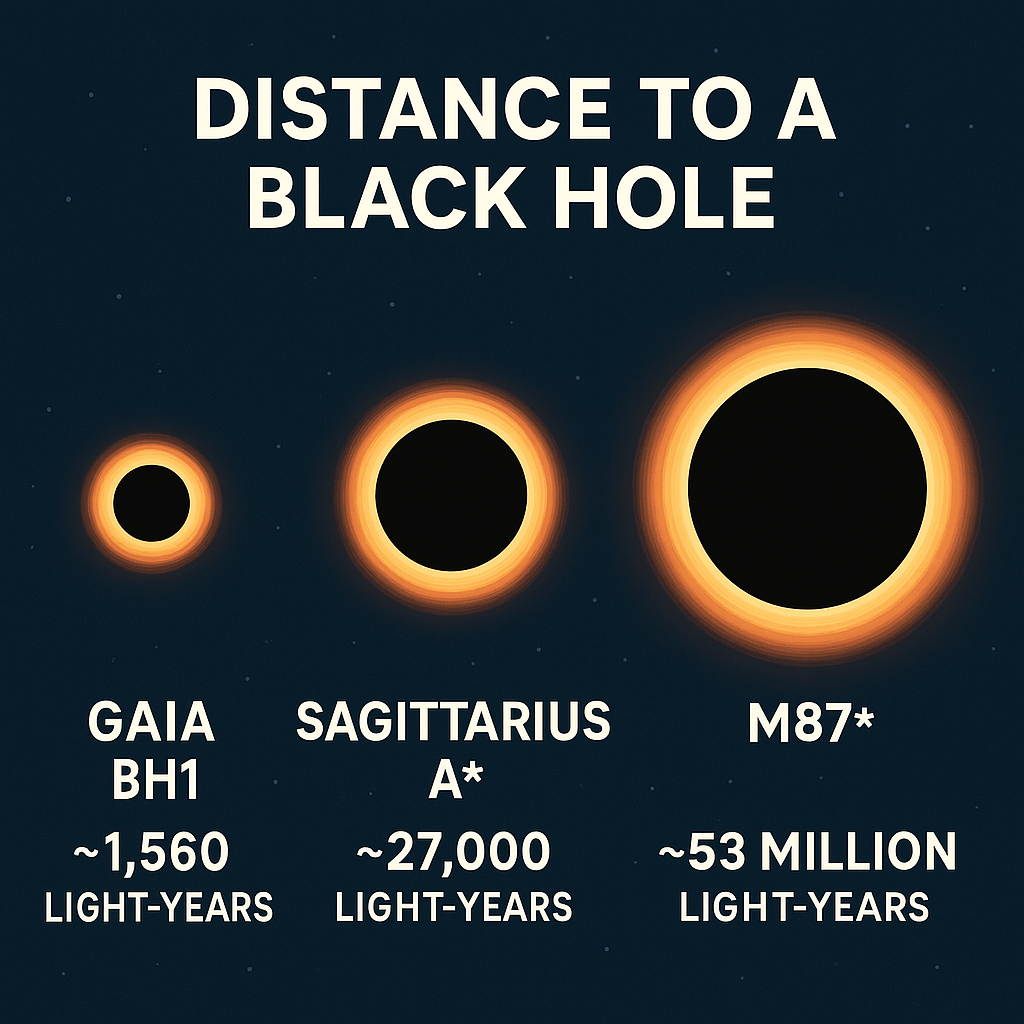
    The distance to a black hole from Earth depends on which black hole you’re talking about. Here are the most well-known ones, with accurate and simple details:


    1. 🕳️ Sagittarius A* (The black hole at the center of our galaxy)

    • 📍 Location: Center of the Milky Way galaxy
    • 📏 Distance: About 27,000 light-years from Earth
    • 🌌 Mass: ~4 million times the mass of the Sun
    • 📸 First imaged by the Event Horizon Telescope in 2022

    2. 🕳️ M87* (The first black hole ever imaged)

    • 📍 Location: In the Messier 87 galaxy, a giant elliptical galaxy in the Virgo Cluster
    • 📏 Distance: About 53 million light-years from Earth
    • 🌌 Mass: ~6.5 billion times the mass of the Sun
    • 📸 Imaged in 2019 (the famous “donut” picture)

    3. 🕳️ Closest Known Black Hole (Confirmed)

    💫 Gaia BH1

    • 📍 Location: In the constellation Ophiuchus
    • 📏 Distance: Only about 1,560 light-years away
    • 🧲 Mass: About 10 times the mass of the Sun
    • 🔭 Discovered in 2022 using data from the Gaia Space Observatory

    🔭 Summary Table

    Black HoleDistance from EarthLocationType
    Gaia BH1~1,560 light-yearsConstellation OphiuchusClosest known
    Sagittarius A*~27,000 light-yearsCenter of Milky WaySupermassive
    M87*~53 million light-yearsGalaxy M87 (Virgo Cluster)Supermassive

  • what is warm hole and how its look like?

    🌀 1. Wormholes (Einstein–Rosen Bridges)

    🧠 Concept:

    A wormhole is a hypothetical tunnel or “bridge” that connects two distant points in space and time.

    • Think of space-time as a folded sheet of paper.
    • A wormhole is like punching a hole through it, connecting two locations instantly.

    📚 Origin:

    • Predicted by Einstein and Rosen in 1935.
    • Mathematically valid solutions to general relativity equations.

    🔗 Types:

    • Traversable wormholes: Can be passed through safely — require exotic matter with negative energy to stay open.
    • Non-traversable wormholes: Collapse too quickly or are blocked.

    ⏳ Time Travel Possibility:

    • If one end of a wormhole is moved near a black hole or accelerated to high speed (relativistic time dilation), the ends could be at different times.
    • Traveling through it would be like going into the past or future — in theory.

    🔁 2. Closed Timelike Curves (CTCs)

    🧠 Concept:

    A closed timelike curve is a path through space-time that loops back to the same point in time — like a circular timeline.

    • It means a particle (or person) could return to their own past.
    • Predicted in some solutions of general relativity (e.g., Gödel Universe, Tipler cylinders, Kerr black holes).

    ⛔ Problems:

    • Creates paradoxes: What if you go back in time and stop yourself from being born? (Grandfather Paradox)
    • Violates causality — the idea that cause comes before effect.

    👨‍🔬 Status:

    • Theoretically possible, but we don’t know if they can exist in reality.
    • Most require infinite energy, exotic matter, or break known laws of physics.

    🧩 Summary Table

    ConceptWormholeClosed Timelike Curve
    ShapeTunnel-like bridgeLoop in time
    Time TravelYes (under some conditions)Yes (backward in time)
    Requires Exotic MatterYesUsually yes
    Paradox RiskMediumHigh
    Real EvidenceNoneNone

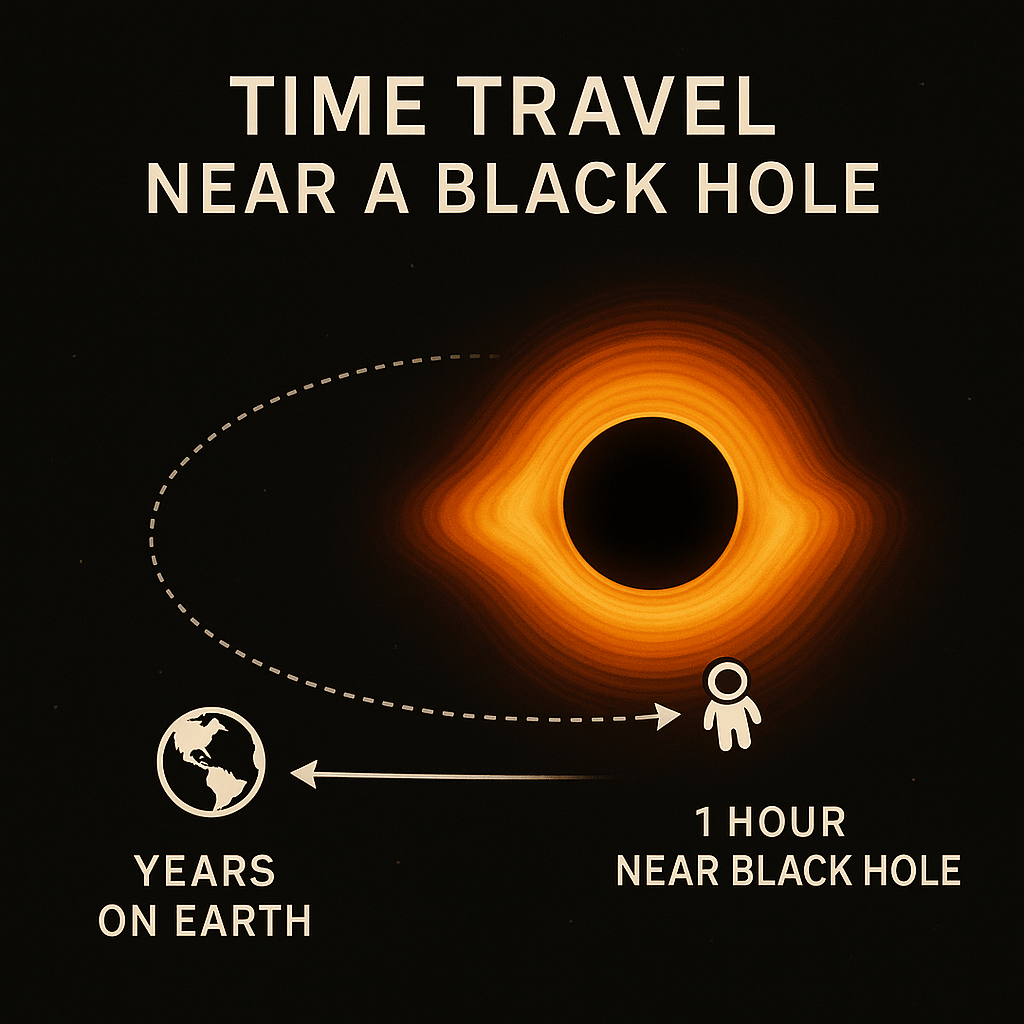
  • Time travel near a black hole is theoretically possible — but only in a specific sense:

    YES: Time Dilation (Forward Time Travel)

    🔭 What happens:

    • Near a black hole, gravity is extremely strong.
    • According to Einstein’s General Relativity, time moves slower in stronger gravitational fields.

    ⏳ So if you:

    • Orbit a black hole (especially a rotating one) near the event horizon,
    • Then come back to Earth after, say, 1 hour,
    • You might find that years have passed on Earth.

    This is a kind of forward time travel — proven by both theory and small-scale experiments (like with atomic clocks in airplanes or satellites).

    This is real and possible (in theory), though we can’t yet travel near a black hole safely.


    NO: Backward Time Travel

    • Going back in time is not supported by current physical laws.
    • Some solutions to Einstein’s equations (like wormholes or closed timelike curves) suggest it might be possible.
    • But these require exotic matter, negative energy, or violate causality — and none of this is proven or physically realistic yet.

    🌀 Rotating Black Holes (Kerr Black Holes) & Wormholes

    • Theorists like Kip Thorne showed that wormholes might connect two different points in space and time.
    • If stabilized, they could potentially be time machines.
    • But it’s all speculative — we don’t have the technology or the exotic materials.

    🎬 Pop Culture Example

    In Interstellar, the character spends time near a supermassive black hole (Gargantua), and when he returns, 23 years have passed outside while only hours passed for him — this is real physics (time dilation).


    Would you like an image or animation explaining time dilation around a black hole visually?

  • What is actual shape of Black Hole?

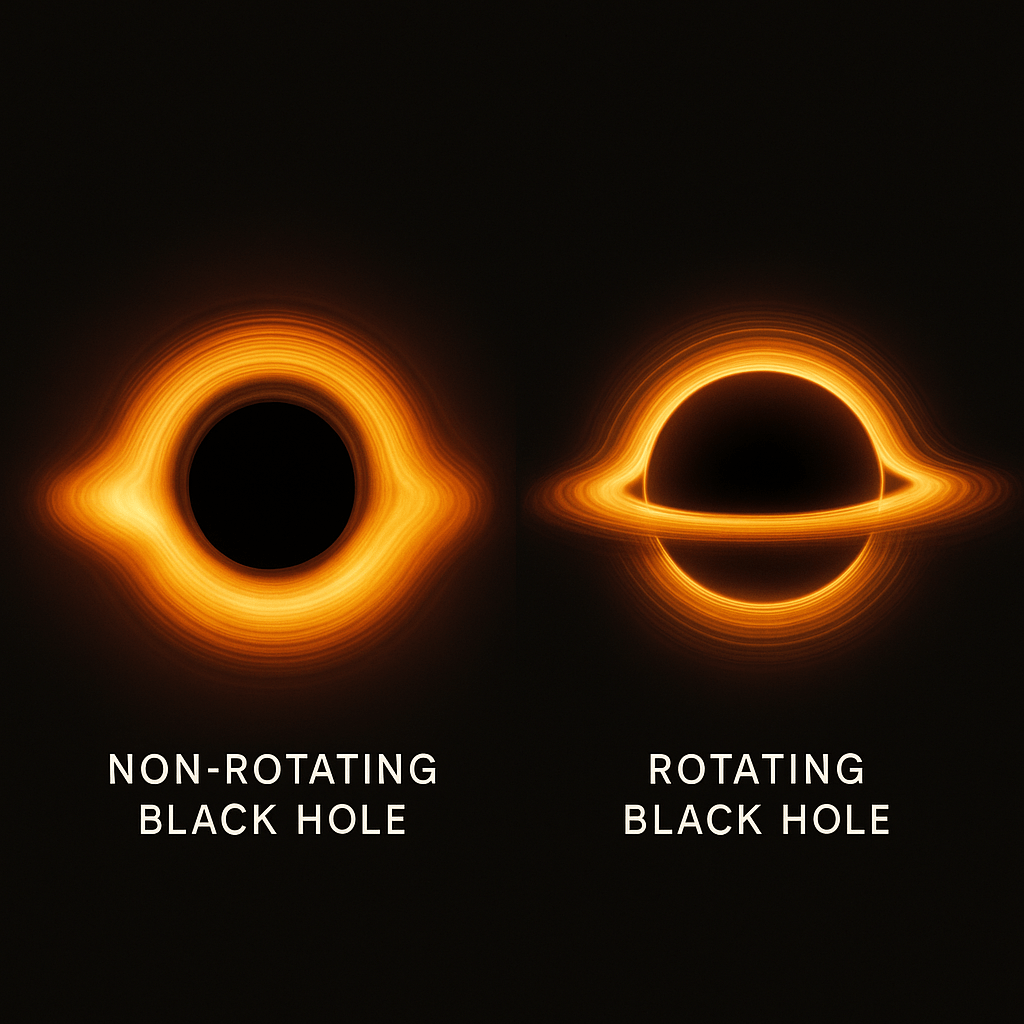
    The actual shape of a black hole depends on how you’re looking at it:


    🔵 1. Non-Rotating Black Hole (Schwarzschild Black Hole)

    • Shape: Perfectly spherical.
    • It’s a symmetric sphere of space where gravity pulls equally in all directions.
    • Nothing can escape beyond the event horizon — a spherical boundary.

    🌀 2. Rotating Black Hole (Kerr Black Hole)

    • Shape: Flattened sphere or oblate spheroid.
    • Due to its spin, the black hole bulges slightly at the equator (like Earth).
    • It also has:
      • A flattened event horizon.
      • An ergosphere — a region outside the event horizon where space is dragged by rotation.

    👁️‍🗨️ What We See (Shadow of a Black Hole)

    • When astronomers image a black hole (like in the famous M87 black hole photo), they don’t see the black hole itself, but its shadow.
    • The shape of that shadow is circular, even for spinning black holes — due to how light bends around it.

    📷 First Real Image (M87, 2019 – Event Horizon Telescope)

    • The dark shadow is nearly circular.
    • Surrounded by a glowing ring of hot plasma falling into the black hole.
    • This supports general relativity’s prediction of a roughly spherical or slightly oblate shape.

    Would you like a visual showing both types — spherical vs rotating black hole — side by side?

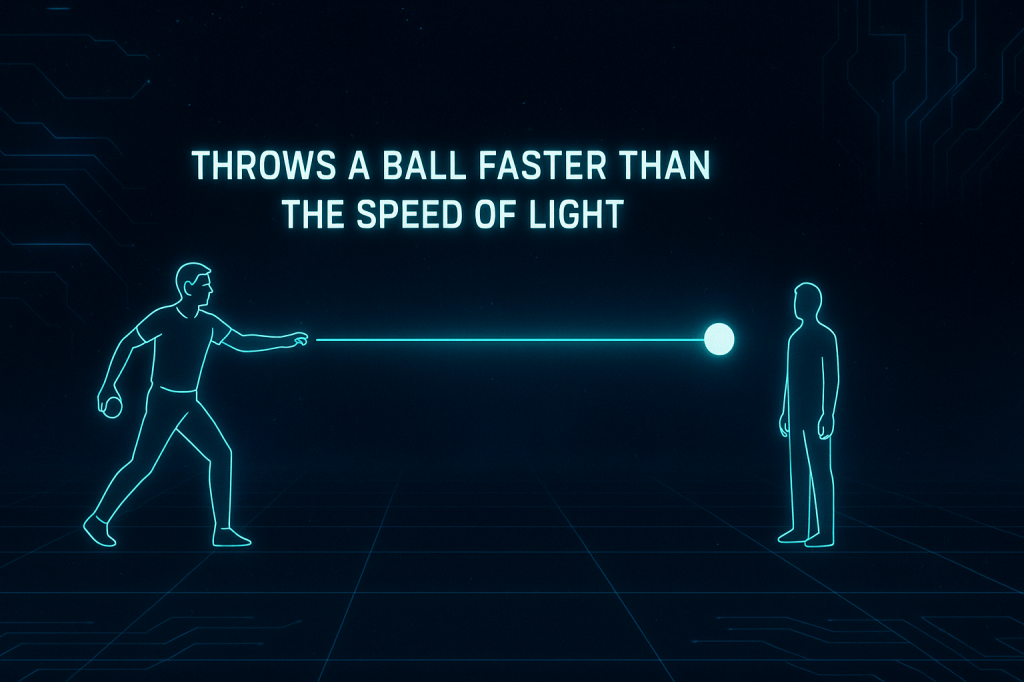
  • What will happen if You throw A Ball faster than Light speed

    Throwing a ball faster than the speed of light is not possible according to our current understanding of physics, specifically Einstein’s theory of relativity. But let’s break this down into interesting and understandable points:


    🚫 Why You Can’t Throw a Ball Faster than Light

    1. Speed of Light Limit (c ≈ 3×10⁸ m/s):
      According to special relativity, nothing with mass can reach or exceed the speed of light. It would require infinite energy.
    2. Mass Increases with Speed:
      As an object with mass speeds up, its relativistic mass increases, making it harder to accelerate. Near light speed, it becomes effectively “infinitely heavy.”

    🤯 What Would Happen If It Could Happen (Hypothetical/Fiction)

    Let’s imagine a universe where a ball goes faster than light:

    1. Time Travel?

    • According to relativity, faster-than-light motion could imply going backward in time.
    • The ball might appear to arrive before it was thrown — which breaks causality (cause before effect).

    2. Causality Paradox:

    • If you can send something back in time, you could change the past, leading to paradoxes like the “grandfather paradox.”

    3. Tachyon-like Effects:

    • Theoretical particles called tachyons (hypothetical) are always faster than light.
    • But they can’t slow down to or below light speed, and they behave in very weird, non-causal ways.

    4. Energy Distortion and Infinite Energy:

    • The throw would require infinite kinetic energy.
    • The ball might rip through spacetime, possibly causing gravitational distortions, or create a black hole-like singularity.

    ⚠️ Final Word

    No known force, object, or mechanism can make a mass-bearing object move faster than light. It’s a hard speed limit in our universe — just like nothing in math can be divided by zero, nothing can go faster than light.

  • Do You Know Size Of the Universe ?

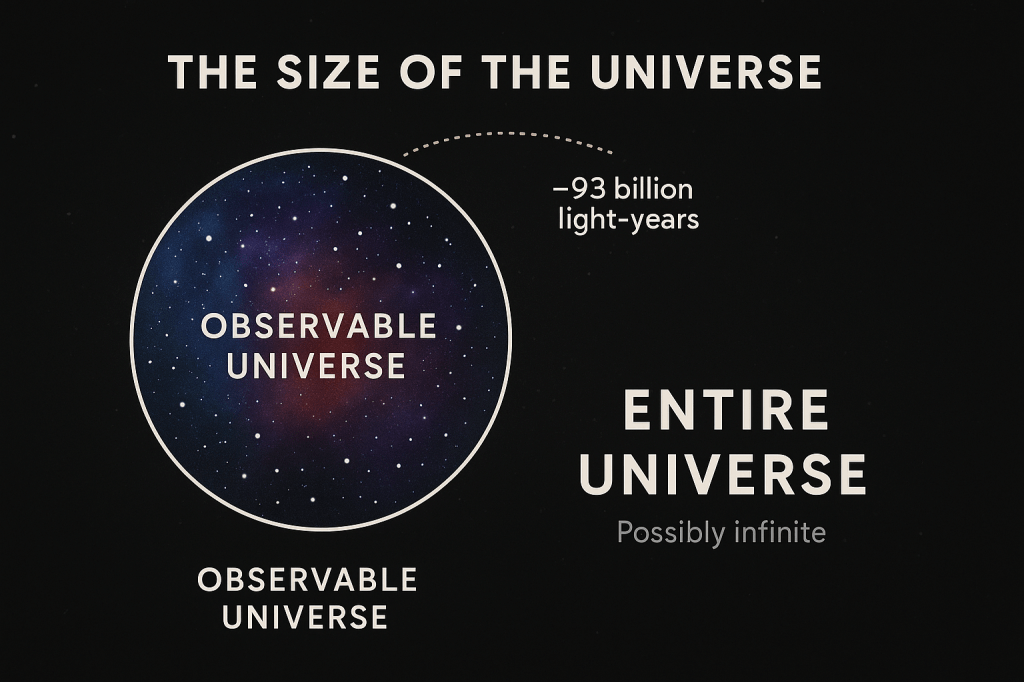
    🌌 1. Observable Universe (What We Can See)

    📏 Diameter:

    About 93 billion light-years

    • That means light from the farthest galaxies we can detect has taken 13.8 billion years to reach us.
    • But due to expansion of space, those galaxies are now ~46.5 billion light-years away in all directions.
    • So the full observable universe spans a 93-billion light-year diameter.

    🧠 Imagine: You’re looking at galaxies that are so far away, you’re seeing them as they were just after the Big Bang.


    🌠 2. Entire Universe (Including Beyond What We Can See)

    We don’t know its true size.

    But most cosmologists believe:

    • The entire universe is much larger than the observable part.
    • It might be infinite in size — or at least 250 times bigger than what we can observe.

    🔭 Why Can’t We See It All?

    • Because light takes time to travel.
    • The universe is only 13.8 billion years old.
    • So we can only see objects whose light has had time to reach us.

    🌐 Universe Expansion & Growth

    • The universe is expanding — galaxies are moving away from us.
    • Space itself is stretching, making distant objects move faster (even faster than light — relativity allows this because it’s space that’s expanding).

    📌 Summary

    TypeSize Estimate
    Observable Universe~93 billion light-years across
    Entire UniversePossibly infinite