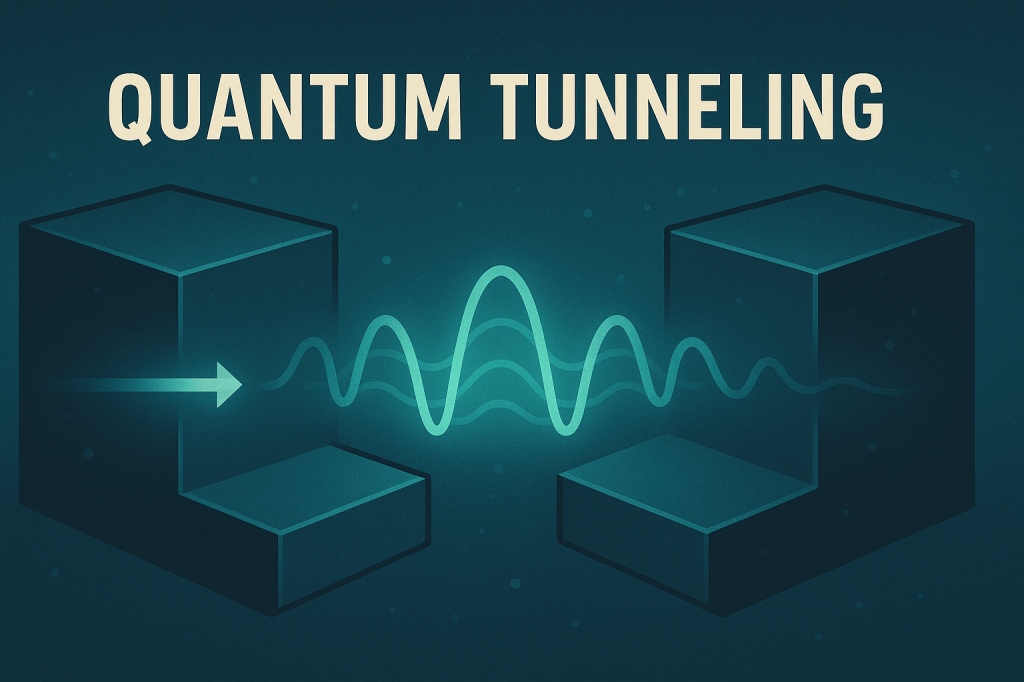
🔍 Basic Explanation:
In classical physics:
- If a ball rolls toward a hill but doesn’t have enough energy to climb over it, it rolls back.
In quantum physics:
- Particles like electrons are not just points—they behave like waves.
- When a wave hits a barrier, part of it can “leak through.”
- This means there’s a small probability the particle appears on the other side of the barrier, as if it “tunneled” through it.
🧠 Why it happens:
- Quantum mechanics describes particles with a wavefunction, which tells you the probability of finding the particle at different places.
- If the wavefunction doesn’t go to zero at the barrier, there’s a chance the particle is found beyond the barrier.
- This is not magic—just one of the strange but tested rules of quantum physics.
🧪 Real-World Examples:
- Nuclear fusion in the Sun:
- Protons in the Sun’s core tunnel through their repulsive barriers to fuse and produce energy.
- Scanning tunneling microscope (STM):
- Works by measuring tunneling current between a sharp tip and a surface—used to image atoms!
- Quantum computing:
- Qubits can tunnel between states—used in certain types of quantum logic.
📊 Key Features:
- Occurs only at the quantum scale.
- Depends on barrier width and height—narrower or lower barriers increase tunneling chance.
- Does not violate energy conservation, because the particle’s presence is probabilistic, not deterministic.
⚛️ Why Tunneling Is Negligible for Large Objects:
1. De Broglie Wavelength Shrinks with Mass
- In quantum mechanics, every particle has a wavelength given by: λ=hp\lambda = \frac{h}{p} where hh is Planck’s constant and pp is momentum.
- For large particles, momentum is high → wavelength becomes tiny → their wave-like nature disappears.
- So, large objects don’t “spread out” as waves and can’t meaningfully “leak” through barriers.
2. Tunneling Probability Drops Exponentially
- The tunneling probability is given by an expression like: P∝e−2⋅(mass)⋅(barrier width)P \propto e^{-2 \cdot \text{(mass)} \cdot \text{(barrier width)}}
- As mass increases, this probability shrinks incredibly fast—basically to zero for large objects.
Example: For an electron, tunneling through a nanometer-scale barrier is quite likely.
For a tennis ball to tunnel through a wall? The probability is something like once every 10103010^{10^{30}} years. That’s more than the age of the universe squared!
3. Environmental Interactions (Decoherence)
- Large particles constantly interact with their environment (air, photons, etc.).
- These interactions cause quantum decoherence, collapsing the wave-like behavior and forcing classical behavior.
- So even if tunneling were theoretically possible, real-world interference kills it immediately.
📌 In Short:
| Feature | Small Particles (Electrons, Protons) | Large Objects (Humans, Balls) |
|---|---|---|
| Wavelength | Noticeable | Extremely tiny |
| Tunneling chance | Significant | Practically zero |
| Decoherence | Minimal | Immediate |
🎯 Summary:
Large particles don’t tunnel because:
- Their wave nature is too small to matter.
- Tunneling probability becomes astronomically low.
- Environmental interactions enforce classical behavior.
Excellent question — and yes, this is a hot topic in neuroscience, physics, and philosophy. Let’s explore it clearly.
🧠 Is Quantum Tunneling Happening in the Brain?
✅ Technically, Yes — But…
- Quantum tunneling can happen inside atoms and molecules, including those in your brain cells.
- Electrons may tunnel between atoms in neural proteins or ion channels, especially in nanometer-sized biological structures.
So yes — quantum tunneling likely occurs at a microscopic level in brain chemistry.
❓But Does That Affect Consciousness or Thinking?
🚫 Probably Not in Any Meaningful Way
- The brain is a warm, wet, and noisy environment.
- Decoherence — the destruction of quantum effects by environmental interaction — happens extremely fast in such conditions.
- This makes quantum effects like tunneling too short-lived to influence large-scale brain activity like thought, memory, or emotion.
🧠 Then Why Do People Talk About It?
🧪 Some Famous Theories Suggest a Link:
- Penrose–Hameroff Theory (Orch-OR)
- Proposed that quantum coherence and tunneling happen in brain microtubules.
- Claims this might explain consciousness.
- Criticism: No strong experimental proof; coherence would likely collapse too fast.
- Speculative Quantum Biology
- Some propose tunneling could play a role in olfaction (how we smell) or enzymatic reactions in the brain.
- These are very small-scale processes, not full thoughts or decisions.
⚖️ Current Scientific Consensus:
| Aspect | Likely? | Relevance |
|---|---|---|
| Electron tunneling in molecules | ✅ Yes | Basic chemistry, not thought |
| Tunneling affecting neuron firing or consciousness | 🚫 Unlikely | No evidence |
| Quantum effects explaining free will or soul | ❌ No scientific basis | Pure speculation |
🧬 Bottom Line:
Quantum tunneling happens at the molecular level in your brain, just like everywhere else in biology.
But it probably plays no role in how you think, feel, or make decisions.
 News Todays 1
Leave a comment