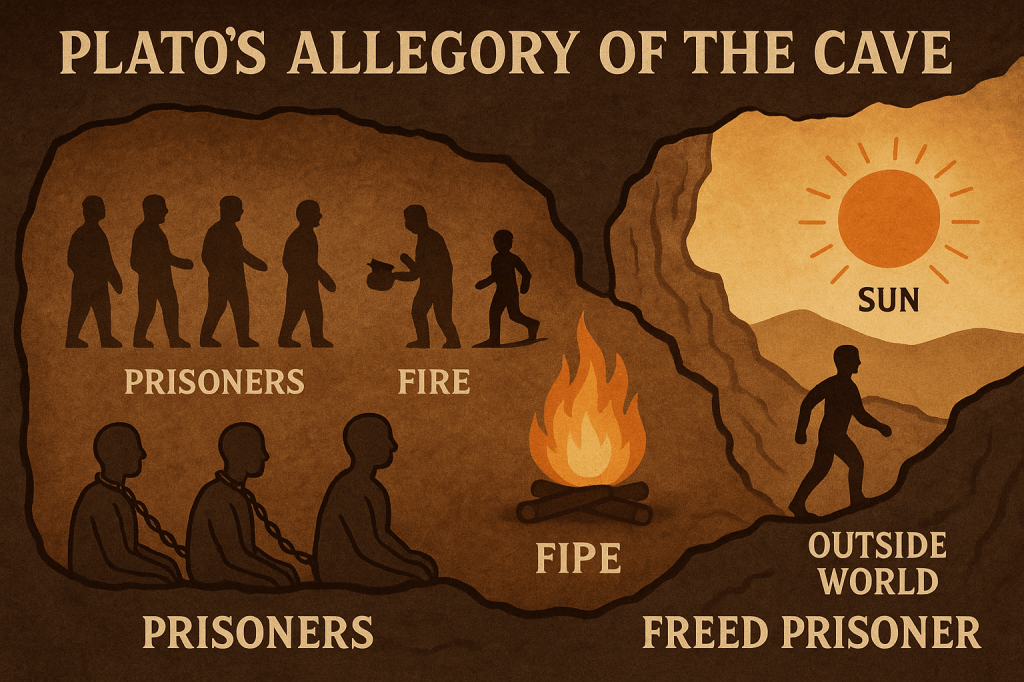
Plato’s Allegory of the Cave is one of the most famous metaphors in philosophy.
It appears in his book “The Republic”, around 380 BCE.
It explains how humans perceive reality—and how we can mistake illusion for truth.
🗿 The Setup: Prisoners in a Cave
Imagine this:
- Prisoners are chained inside a dark cave from birth.
- They can only see the wall in front of them.
- Behind them is a fire and some people carrying objects.
- The objects cast shadows on the wall.
🧍♂️➡️🔥👤
(Prisoner → Fire → Objects → Shadow)
They think the shadows are real things, because that’s all they’ve ever seen.
🤯 What Happens Next?
One prisoner is freed.
- At first, he’s blinded by the firelight.
- Then he’s dragged outside the cave—and sees the real world: trees, sky, sunlight.
- At first he’s confused, but eventually realizes: “What I saw in the cave was only shadows—not real reality!”
🧠 The Deeper Meaning
| Cave Element | Symbolizes |
|---|---|
| Prisoners | Ordinary people |
| Shadows | Illusions or false beliefs |
| Fire | Fake source of truth (limited knowledge) |
| Outside World | True reality or higher knowledge |
| The Sun | Ultimate truth or enlightenment |
| Freed Prisoner | The philosopher or seeker of truth |
📜 Plato’s Message:
- Most people live in ignorance, accepting only what they see (shadows).
- Truth is difficult, and stepping out of ignorance is painful at first.
- Enlightenment requires effort, education, and a willingness to question everything.
- Those who discover the truth (like philosophers) may be mocked or ignored by those still in the cave.
🧘♂️ Why It Still Matters
- It relates to modern illusions—media, politics, social bubbles.
- It connects to ideas in simulation theory, matrix-like worlds, and spiritual awakening.
- It’s a warning: “Don’t settle for the shadows. Seek the source.”
Would you like a visual image of this allegory as a diagram or scene?
 News Todays 1
Leave a comment