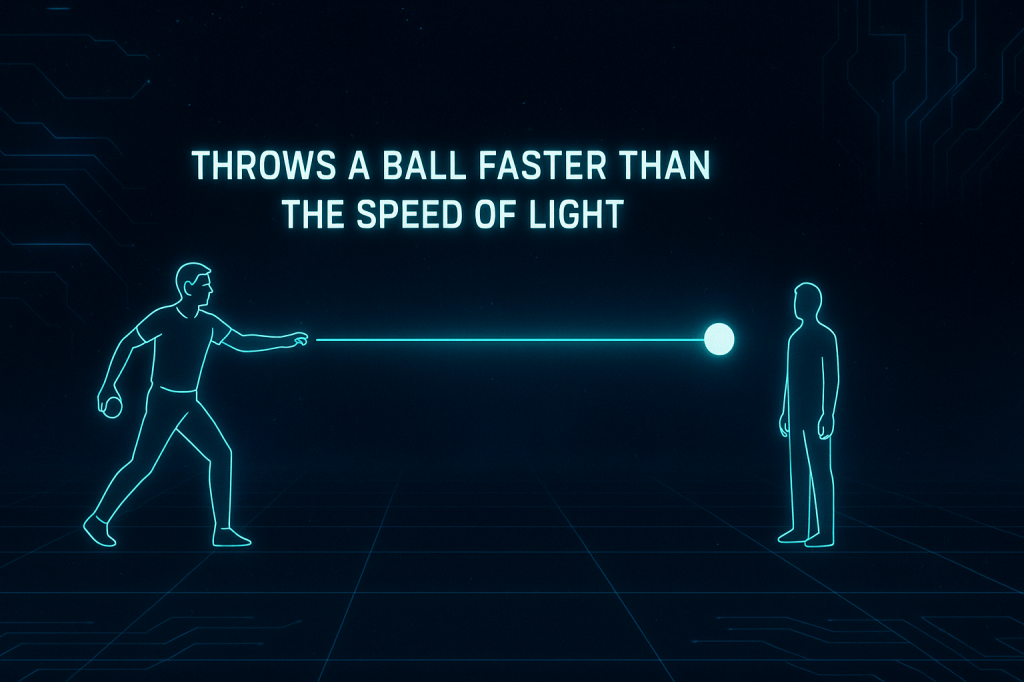
Throwing a ball faster than the speed of light is not possible according to our current understanding of physics, specifically Einstein’s theory of relativity. But let’s break this down into interesting and understandable points:
🚫 Why You Can’t Throw a Ball Faster than Light
- Speed of Light Limit (c ≈ 3×10⁸ m/s):
According to special relativity, nothing with mass can reach or exceed the speed of light. It would require infinite energy. - Mass Increases with Speed:
As an object with mass speeds up, its relativistic mass increases, making it harder to accelerate. Near light speed, it becomes effectively “infinitely heavy.”
🤯 What Would Happen If It Could Happen (Hypothetical/Fiction)
Let’s imagine a universe where a ball goes faster than light:
1. Time Travel?
- According to relativity, faster-than-light motion could imply going backward in time.
- The ball might appear to arrive before it was thrown — which breaks causality (cause before effect).
2. Causality Paradox:
- If you can send something back in time, you could change the past, leading to paradoxes like the “grandfather paradox.”
3. Tachyon-like Effects:
- Theoretical particles called tachyons (hypothetical) are always faster than light.
- But they can’t slow down to or below light speed, and they behave in very weird, non-causal ways.
4. Energy Distortion and Infinite Energy:
- The throw would require infinite kinetic energy.
- The ball might rip through spacetime, possibly causing gravitational distortions, or create a black hole-like singularity.
⚠️ Final Word
No known force, object, or mechanism can make a mass-bearing object move faster than light. It’s a hard speed limit in our universe — just like nothing in math can be divided by zero, nothing can go faster than light.

 News Todays 1
Leave a comment