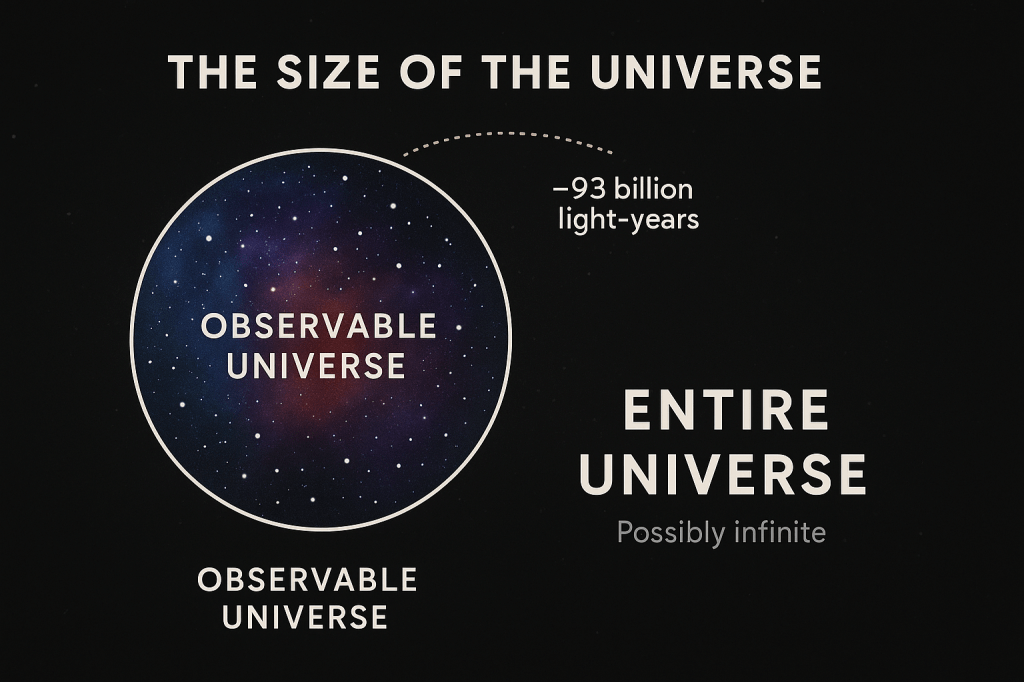
🌌 1. Observable Universe (What We Can See)
📏 Diameter:
About 93 billion light-years
- That means light from the farthest galaxies we can detect has taken 13.8 billion years to reach us.
- But due to expansion of space, those galaxies are now ~46.5 billion light-years away in all directions.
- So the full observable universe spans a 93-billion light-year diameter.
🧠 Imagine: You’re looking at galaxies that are so far away, you’re seeing them as they were just after the Big Bang.
🌠 2. Entire Universe (Including Beyond What We Can See)
We don’t know its true size.
But most cosmologists believe:
- The entire universe is much larger than the observable part.
- It might be infinite in size — or at least 250 times bigger than what we can observe.
🔭 Why Can’t We See It All?
- Because light takes time to travel.
- The universe is only 13.8 billion years old.
- So we can only see objects whose light has had time to reach us.
🌐 Universe Expansion & Growth
- The universe is expanding — galaxies are moving away from us.
- Space itself is stretching, making distant objects move faster (even faster than light — relativity allows this because it’s space that’s expanding).
📌 Summary
| Type | Size Estimate |
|---|---|
| Observable Universe | ~93 billion light-years across |
| Entire Universe | Possibly infinite |
 News Todays 1
Leave a comment