Introduction
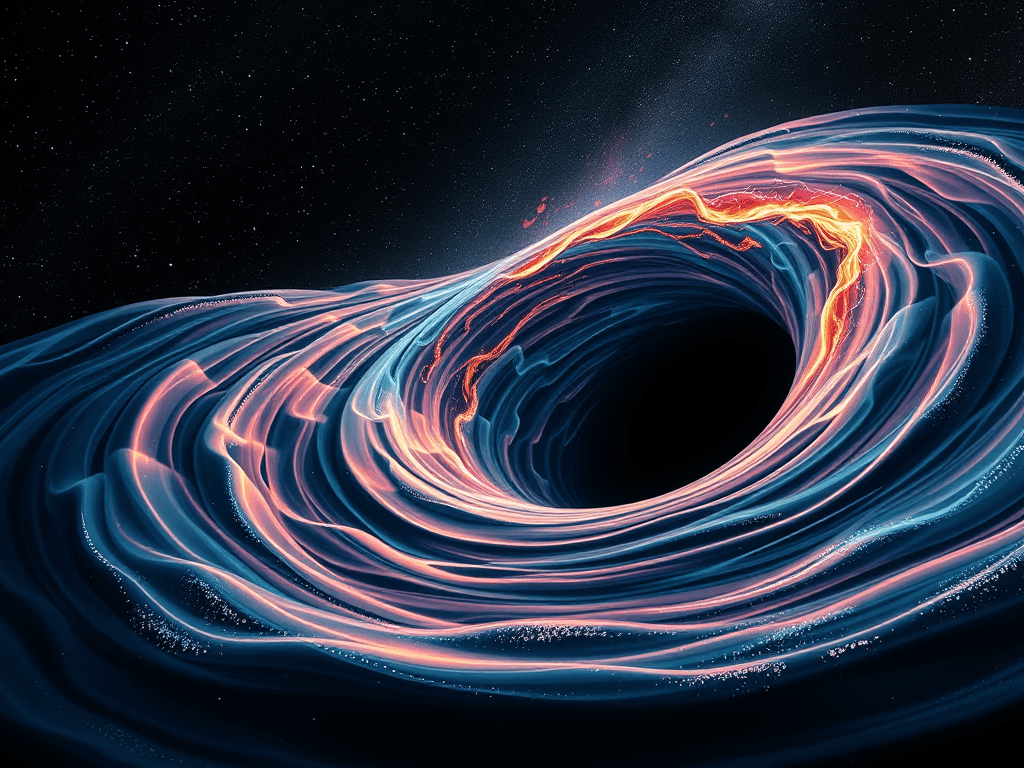
Gravitational waves are ripples in the fabric of spacetime, predicted by Einstein’s General Theory of Relativity (1915) and first directly detected in 2015 by LIGO (Laser Interferometer Gravitational-Wave Observatory). These waves are generated by the most violent cosmic events—merging black holes, neutron stars, and supernovae—and provide a new way to observe the universe.
1. What Are Gravitational Waves?
- Cause: Accelerating massive objects (e.g., orbiting black holes) warp spacetime, sending out waves at the speed of light.
- Properties:
- Frequency: Ranges from 10⁻⁴ Hz (supermassive black holes) to 10³ Hz (stellar mergers).
- Amplitude: Extremely weak—a passing wave may stretch a 4 km detector by less than a proton’s width!
2. How Are They Detected?
A. LIGO & Virgo (Ground-Based Interferometers)
- Method: Laser beams travel down 4 km arms; a passing wave alters their path length.
- Sensitivity: Detects strains of ΔL/L ~ 10⁻²¹.
- Key Detection:
- GW150914 (2015): First observation of two black holes merging (29+36 M☉, 1.3 billion light-years away).
B. Future Detectors
- LISA (2030s): Space-based interferometer for low-frequency waves (supermassive black hole mergers).
- Pulsar Timing Arrays (NANOGrav): Uses millisecond pulsars to detect nanohertz waves from cosmic strings.
3. Sources of Gravitational Waves
| Source | Frequency | Example Event |
|---|---|---|
| Binary Black Holes | 10–1000 Hz | GW150914 (LIGO) |
| Binary Neutron Stars | 100–2000 Hz | GW170817 (with gamma-ray burst) |
| Supernovae | 10–1000 Hz | Not yet detected |
| Cosmic Inflation | 10⁻¹⁸–10⁻¹⁶ Hz | Primordial B-modes (future CMB probes) |
4. Scientific Breakthroughs Enabled
🔹 First “Hearing” of Black Hole Mergers – Confirmed predictions of GR in extreme gravity.
🔹 Multi-Messenger Astronomy (GW170817) – Gravitational waves + light (kilonova) revealed neutron star mergers create heavy elements (gold, platinum).
🔹 Tests of General Relativity – No deviations found (yet) from Einstein’s equations.
5. Unsolved Mysteries
❓ Do Intermediate-Mass Black Holes Exist? (LIGO may find 100–10⁵ M☉ mergers.)
❓ What Causes Fast Radio Bursts? (Some may coincide with gravitational waves.)
❓ Are There Exotic Sources? (Cosmic strings, quark stars?)
6. Future Prospects
🔹 Third-Generation Detectors (Einstein Telescope, Cosmic Explorer): 10x more sensitive.
🔹 Quantum-Enhanced Interferometers: Squeezed light to beat the standard quantum limit.
#GravitationalWaves #LIGO #GeneralRelativity #BlackHoles #Astrophysics
Want details on how LIGO filters out seismic noise? Ask below! 🌌🔭
References
[1] Abbott et al. (2016). Observation of Gravitational Waves from a Binary Black Hole Merger. PRL, 116(6).
[2] The LIGO Scientific Collaboration (2019). GWTC-1: A Gravitational-Wave Transient Catalog. arXiv:1811.12907.
[3] Amaro-Seoane et al. (2017). LISA: Probing the Universe with Gravitational Waves. arXiv:1702.00786.
 News Todays 1
Leave a comment