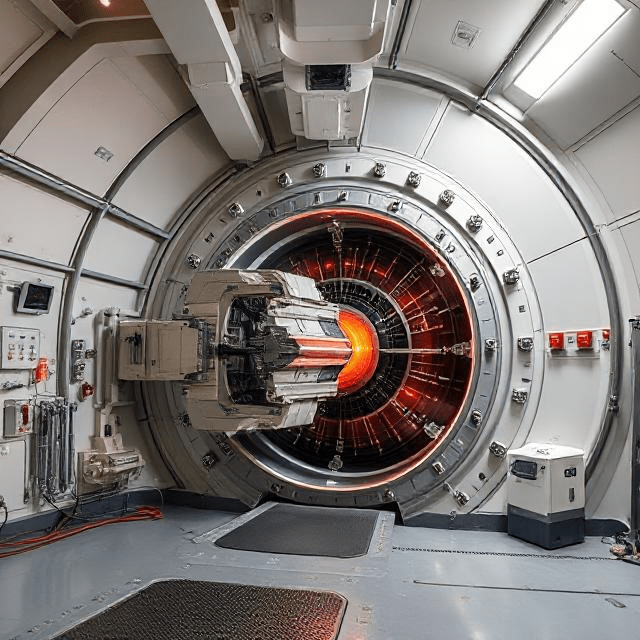
Particle accelerators are the ultimate tools for exploring the fundamental building blocks of the universe. The largest ones push particles to near-light speeds, creating extreme conditions that replicate the early universe. Here’s a look at the biggest and most powerful particle accelerators in the world.
1. Large Hadron Collider (LHC) – CERN, Switzerland/France
🔹 Circumference: 27 km (17 miles) – Largest in the world
🔹 Energy: 13–14 TeV (trillion electron volts)
🔹 Purpose:
- Discovered the Higgs boson (2012)
- Searches for dark matter, extra dimensions, antimatter
- Tests Standard Model of particle physics
🔹 Next Upgrade: High-Luminosity LHC (HL-LHC, 2029) – 10x more collisions
2. Future Circular Collider (FCC) – Proposed by CERN
🔹 Circumference: 91–100 km (Under study)
🔹 Energy: Up to 100 TeV (7x more powerful than LHC)
🔹 Goal:
- Explore “post-Higgs” physics
- Investigate supersymmetry, quantum gravity
🔹 Timeline: Possible construction by 2040s
3. Super Proton-Proton Collider (SPPC) – China (Proposed)
🔹 Circumference: 52–100 km (Planned for 2035)
🔹 Energy: 50–70 TeV
🔹 Goal:
- Compete with CERN’s FCC
- Study matter-antimatter asymmetry
4. Relativistic Heavy Ion Collider (RHIC) – Brookhaven, USA
🔹 Circumference: 3.8 km
🔹 Energy: 200 GeV (gold ions)
🔹 Purpose:
- Creates quark-gluon plasma (early-universe state)
- Studies proton spin structure
5. Tevatron (Decommissioned) – Fermilab, USA
🔹 Circumference: 6.3 km
🔹 Energy: 1.96 TeV
🔹 Legacy:
- Discovered top quark (1995)
- Paved the way for LHC
6. DESY (Electron Synchrotron) – Germany
🔹 Circumference: 6.3 km (HERA ring, now decommissioned)
🔹 Current Focus:
- PETRA III (X-ray synchrotron for materials science)
- FLASH (Free-electron laser)
7. SLAC (Linear Accelerator) – USA
🔹 Length: 3.2 km (Longest linear accelerator)
🔹 Energy: 50 GeV electrons
🔹 Purpose:
- Stanford Linear Collider (SLC) – Studied Z boson
- LCLS (X-ray laser for molecular imaging)
Future of Giant Accelerators
🔹 Compact Accelerators?
- Plasma wakefield tech could shrink future accelerators (e.g., 1km → 100m)
🔹 International Collaboration? - Next-gen colliders may require global funding (e.g., FCC in Europe vs. SPPC in China)
Conclusion
The LHC remains the king of particle colliders, but future machines like the FCC and SPPC could dwarf it. These megaprojects push the limits of engineering and physics, seeking answers to dark matter, extra dimensions, and the origins of the universe.
Which accelerator do you find most exciting? Comment below!
Want a deep dive into how the LHC detects particles? Let me know! 🔬
 News Todays 1
Leave a comment